
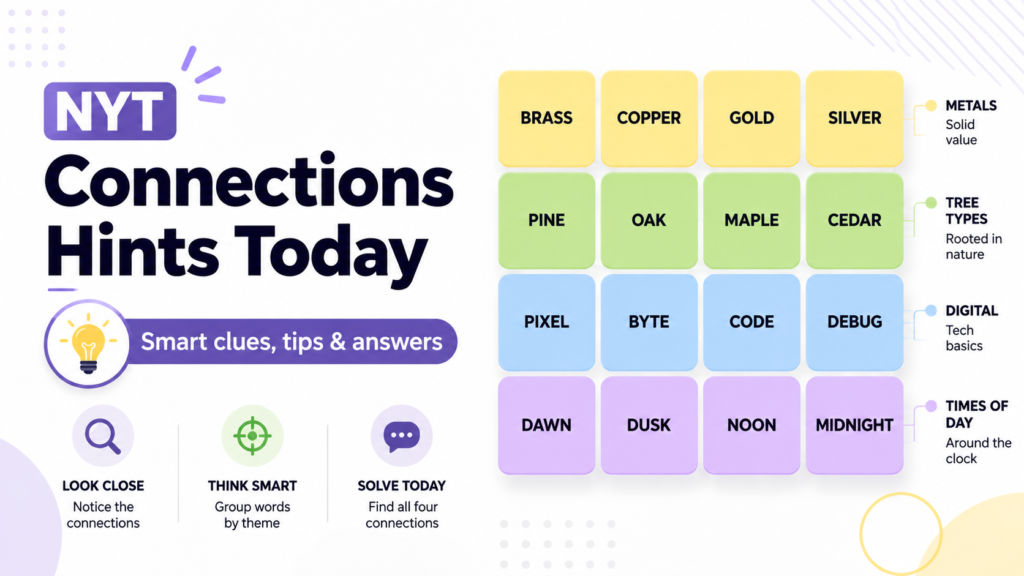
Some days, the Connections grid looks easy for the first ten seconds. Then one word ruins everything.
You spot three words that clearly belong together, but the fourth one keeps hiding. You try a group, the game says “one away,” and suddenly every word on the board feels suspicious. That is exactly why players search for nyt connections hints today before giving up completely.
This guide gives you a clean, spoiler-aware way to approach today’s NYT Connections puzzle. You will get a better understanding of how the game works, how to read the color levels, how to use hints without ruining the fun, and how to avoid the traps that make Connections so addictive.
What Is NYT Connections?
NYT Connections is a daily word puzzle from The New York Times. The game gives you 16 words, and your job is to sort them into four groups of four. Each group has a shared connection, but the connection is not always obvious.
Sometimes the link is simple, such as types of fruit, movie genres, or common verbs. Other times, the answer depends on wordplay, slang, missing words in phrases, homophones, pop culture, geography, or a sneaky double meaning.
The challenge is not just knowing words. It is noticing patterns.
You only get a limited number of mistakes, so random guessing is risky. A good hint can help you think in the right direction without handing you the full solution.
Quick Answer What Are NYT Connections Hints Today?
NYT Connections hints today are daily clues that help players solve the current Connections puzzle without immediately revealing all four answers. A good hints page should show spoiler-free nudges first, then stronger clues, and only reveal the full categories and word groups after a clear spoiler warning.
That structure matters because different players want different levels of help. Some only need a small push. Others want the full solution after trying for a while.
Today’s Connections Hint Format
A helpful daily Connections page should be organized in layers. This makes the experience better for readers and avoids spoiling the puzzle too early.
| Hint Level | Best For | What It Should Include |
|---|---|---|
| Light hint | Players who want a small nudge | Broad category direction |
| Medium hint | Players stuck on one group | More specific theme clue |
| Strong hint | Players close to losing | Category title-style clue |
| Full answer | Players who want the solution | All four groups and words |
This layered format is better than dropping the answers immediately. It respects the player’s choice and keeps the puzzle enjoyable.
How NYT Connections Difficulty Colors Work
Connections groups are usually shown in four colors. These colors indicate the general difficulty of each category.
Yellow: Usually the Easiest
Yellow is normally the most straightforward group. These words often share a direct meaning or belong to an obvious category.
Examples of yellow-style connections may include:
- Types of weather
- Common kitchen items
- Basic colors
- Simple synonyms
- Famous sports
If you are starting the puzzle, look for the yellow group first. It can clear the board and make the harder categories easier to see.
Green: A Little Trickier
Green is usually not too difficult, but it may require a bit more thinking. The connection might still be familiar, but less obvious at first glance.
Green groups often involve:
- Related objects
- Common phrases
- Everyday categories
- Slightly less direct synonyms
If a group feels sensible but not too clever, it may be green.
Blue: More Specific Knowledge
Blue categories often require narrower knowledge. You may need to recognize brands, titles, cultural references, sports terms, music terms, or word families.
Blue is where many players slow down because the words may look unrelated until one theme clicks.
Purple: The Trickiest Group
Purple is usually the most playful or deceptive group. It often involves wordplay, missing words, sounds, endings, prefixes, or references that are not obvious.
Purple categories may include:
- Words that come after the same word
- Words that come before the same word
- Homophones
- Hidden meanings
- Movie or song title patterns
- Slang or idioms
When you are stuck, purple is often the reason.
Best Strategy Before Looking at Today’s Hints
Before checking a hint, give yourself a structured attempt. This helps you improve instead of becoming dependent on answers.
1. Scan for Obvious Categories
First, look for simple groups. Ask yourself:
- Are there four animals?
- Are there four foods?
- Are there four places?
- Are there four verbs?
- Are there four words from the same subject?
Do not submit too quickly. Just notice possible groups.
2. Watch for Red Herrings
Connections loves fake patterns. You may see three words that belong together, plus a fourth word that almost fits. That “almost” word is often bait.
For example, a puzzle might include several sports words, but one of them actually belongs to a movie title category. Another word may look like a food item but really works as slang.
If a group feels too easy but has five possible members, slow down.
3. Use the Shuffle Button
The shuffle button is more useful than it looks. Changing the order of the words can help your brain stop seeing the same false patterns.
If you keep staring at one corner of the grid, shuffle and scan again.
4. Think of Phrases
Many hard Connections groups are based on missing-word phrases.
Try placing a common word before or after each option:
- ___ man
- ___ ball
- ___ light
- hot ___
- black ___
- paper ___
This trick is especially useful for blue and purple categories.
5. Don’t Guess Until You Have Four
Avoid submitting a group just because three words fit. Connections requires all four words to match the intended category.
If you only have three, keep searching.
Spoiler-Free Hint Checklist for Today
Use this checklist before you reveal stronger clues:
- Look for one group based on a clear real-world category.
- Look for one group connected to slang or informal language.
- Look for one group where a word can be used in more than one context.
- Look for one group built around a phrase pattern or title pattern.
- Be careful with words that seem to fit more than one group.
This is the safest way to use nyt connections hints today without losing the satisfaction of solving the puzzle yourself.
Common Mistakes Players Make
Even experienced players lose because Connections is designed to mislead your first instinct.
Mistake 1: Solving Too Fast
The first pattern you see is not always correct. Pause before submitting.
Mistake 2: Ignoring Word Forms
A word may be a noun, verb, adjective, name, brand, or part of a phrase. If one meaning does not work, try another.
Mistake 3: Treating Similar Words as Automatic Groups
Four words may look related, but the official category may be more precise. For example, “apple,” “orange,” “melon,” and “coconut” may look like fruits, but one puzzle could use some of those words in a totally different way.
Mistake 4: Saving the Hardest Group Too Late
Sometimes solving the easy groups first leaves four words that make no sense together. That does not always mean you are right. It may mean you accidentally removed a word that belonged in the hard group.
Mistake 5: Forgetting Pop Culture
Connections often uses references from movies, music, games, sports, books, brands, and idioms. If a group feels impossible, think outside dictionary meanings.
How to Use Hints Without Spoiling the Puzzle
The best way to use a hint is to reveal only one layer at a time.
Start with a broad hint. If that does not help, look at the category direction. Only read the full answer after you have tried to solve the group yourself.
A good routine looks like this:
- Try the puzzle alone for two or three minutes.
- Write down possible groups mentally.
- Check one light hint.
- Return to the grid.
- Use a stronger hint only if needed.
- Reveal answers last.
This keeps the game fun and still protects your streak.
Why Connections Feels Harder Than Wordle
Wordle is about narrowing one answer through letters. Connections is about interpreting meaning. That makes it feel more unpredictable.
In Connections, one word can point in several directions. “Pitch” could mean a sports field, a sales presentation, a sound quality, or something related to tar. “Delta” could mean a landform, a Greek letter, an airline, or a math symbol.
That flexibility is what makes the puzzle clever. It is also why hints are useful. They help narrow the meaning without removing the challenge.
What Makes a Good Daily Connections Hints Page?
Many daily puzzle articles simply list clues and answers. That can be helpful, but the best pages do more.
A strong daily hints page should include:
- The correct date and puzzle number
- A clear spoiler warning
- Light hints before full answers
- Color-coded category help
- Short explanations of tricky groups
- A beginner-friendly strategy section
- No fake hints or invented categories
- Updates when the daily puzzle changes
For SEO, the page should also answer the user’s need quickly. Someone searching nyt connections hints today probably wants help right away, not a long history lesson before the clues.
Example of a Better Hint Layout
Here is a clean structure you can use for a daily blog post:
Today’s Puzzle Info
Add the date, puzzle number, and a short spoiler warning.
Light Hints
Give one broad clue for each group.
Stronger Hints
Give category-style clues without showing all words.
Full Answers
Reveal each color group and the four correct words.
Explanation
Explain why each group works, especially the blue and purple groups.
Strategy Tip
End with one useful solving tip for tomorrow.
This format works well for readers, featured snippets, and AI search results because the page is clear, scannable, and genuinely helpful.
Should You Look Up Connections Answers?
There is nothing wrong with checking hints. The goal is to enjoy the puzzle.
Some players want to protect a streak. Others are interested in learning how the puzzle works. Newcomers may need help understanding the logic.
Others simply do not want to spend 20 minutes stuck on one strange category.
The healthiest way to use answers is to learn from them. After revealing the solution, ask:
- What was the trick?
- Which word misled me?
- Did the category use slang, phrases, or trivia?
- Could I spot this pattern next time?
That turns a missed puzzle into practice.
Final Thoughts
Connections is fun because it feels simple until it suddenly does not. The best hints do not steal the answer. They point your brain in the right direction.
If you are checking nyt connections hints today, start with light clues first. Try to solve at least one group yourself before revealing the full solution. Pay attention to red herrings, phrase patterns, and alternate meanings.
The more you notice how the puzzle thinks, the better you get.
Tomorrow’s grid will bring a new set of traps, but the same method will still help: slow down, scan carefully, test meanings, and only use hints when they keep the game enjoyable.
FAQs
What is NYT Connections?
NYT Connections is a daily word puzzle where players sort 16 words into four groups of four. Each group has a hidden connection, such as a category, phrase pattern, synonym set, cultural reference, or wordplay theme.
Are Connections hints the same as answers?
No. Hints give clues that help you solve the puzzle yourself. Answers reveal the exact categories and word groups. A good daily guide should separate hints from answers with a clear spoiler warning.
What time does NYT Connections update?
The puzzle usually updates daily, but the exact “today” can depend on your time zone. That is why daily hints pages should include the date and puzzle number clearly.
What is the hardest Connections color?
Purple is usually the hardest category. It often involves wordplay, missing words, homophones, pop culture, or hidden patterns that are not obvious from the first reading.
How can I get better at NYT Connections?
Start with obvious categories, avoid guessing too early, use the shuffle button, think of multiple meanings, and check for phrase patterns. Reviewing past answers can also help you recognize common puzzle tricks.
Is it cheating to use NYT Connections hints?
Not really. Many players use hints to keep the game fun. If you want the challenge, use spoiler-free clues first and only reveal full answers after you have made a real attempt.
For more updates visit: Wordle Hints Today